

Investments in securities involve risks. The content of this website does not constitute investment advice, a recommendation or an invitation to purchase financial instruments.
Wealth Accumulation: A Clear Plan for Long-Term Growth
Your Path to Financial Growth
Wealth accumulation often starts with one simple question: what do you want to build over time? If you want to grow savings, prepare for future goals, or understand how investing may fit into a long-term plan, it helps to start with clear basics and realistic expectations. This page explains wealth accumulation basics, including saving, investing, common investment types, and practical steps for building wealth over time.
What Wealth Accumulation Means
Wealth accumulation means building savings and investments over time in a way that fits your goals, time frame, and personal financial situation. It is not only about setting money aside. It also means deciding what should stay available in cash, what can be invested for longer, and which risks may be acceptable.
For many people, it begins with a financial buffer and grows through regular contributions, long-term planning, and consistency. Over time, reinvested returns may support further growth, while inflation, costs, and risk still need to be reviewed carefully.

Saving vs Investing for Wealth Accumulation
Wealth accumulation often involves both saving and investing, but they are usually used for different purposes. One is often linked to access and stability, while the other is more often reviewed in relation to longer holding periods and return potential.

Stability Through Saving
Saving is often used for planned expenses, emergency reserves, or money that may be needed without delay. Its main role is usually flexibility and availability. That can be useful, but over longer periods cash alone may lose purchasing power if inflation remains above deposit returns.

Investing For Growth
Investing is often considered for money that does not need to remain fully liquid and can stay committed for longer. Options such as funds, ETFs, bonds, or shares may be reviewed for this purpose. Values can rise or fall over time, and losses are possible, so the comparison should include both opportunity and risk.

The Role of Budgeting in Wealth Accumulation
Budgeting helps you see what is happening in your finances before planning for the long term. By tracking income, fixed costs, variable spending, and commitments, you can understand how much may be available for saving or investing regularly.
A budget is not just about controlling spending. It helps spot patterns, prepare for irregular costs, and reduce the risk that short-term pressures interrupt longer-term goals. Even a simple, flexible budget provides structure, sets priorities, and makes long-term wealth building easier to organise step by step.
5 Steps to Building Wealth Over Time
Wealth accumulation often becomes easier to understand when it is broken into a few practical steps. These steps do not form one fixed rule for everyone, but they can help make the process more concrete.
1. Define What the Money is For
Start with the purpose. Long-term retirement planning, future family costs, capital for a home purchase, or a general reserve may each require a different structure.
2. Review What Already Exists
Look at current savings, debts, regular expenses, and available liquidity. This shows what is already working and where gaps may still exist.

These steps are not a guarantee of any result. They offer a practical way to organise the topic and review the choices involved more clearly.
Which Investments Can Support Wealth Accumulation
ETFs and Funds for Diversification
ETFs and funds are often used in wealth accumulation because a single product can give access to many securities. Portfolios, costs, risks, and their role in broader Wealth management are reviewed before they are used for regular long-term investments.
Bonds Balanced Allocation
Bonds are often reviewed when wealth accumulation needs a different balance between maturity, income, and price risk. They can sit beside other assets in a broader mix, but issuer quality, interest-rate sensitivity, and market conditions still matter.
Stocks for Long-Term Growth
Stocks are often included in long-term wealth accumulation because they provide direct participation in company growth. Prices can rise or fall, so stocks are usually reviewed as part of a diversified structure rather than in isolation.
Why Diversification Matters Over Time
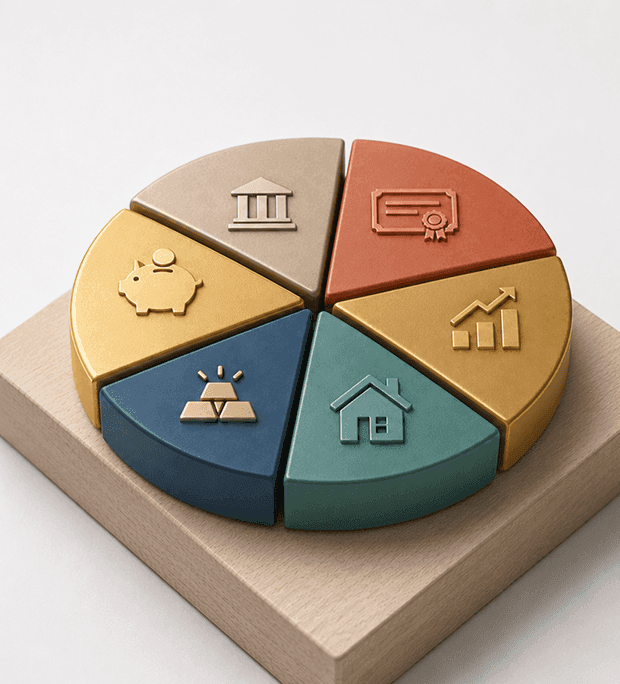
Diversification is often discussed because long-term plans can become more vulnerable when too much depends on one asset, one market, or one investment idea. A broader mix does not remove risk, but it can reduce concentration in a single area.
A Broader Mix Can Support Long-Term Planning
Wealth accumulation usually relies on a mix of assets rather than a single product. Reviewing how different asset types work together can help reduce reliance on any one investment.
What diversification can help you review
Spreading exposure across different asset types
How Wealth Accumulation Works in Real Life
Wealth accumulation usually develops through connected steps, not one fixed formula. Many people begin by reviewing their current situation, defining what the money is for, and choosing a structure they can realistically maintain.
Review Your Current Position
Start by looking at your income, regular expenses, savings, debts, and obligations. This will give you a clearer picture of what's available for long-term planning and what you should focus on first.
Keep a Reserve Available
Many people keep part of their money easily available before taking on more market exposure. This can help protect longer-term holdings from being interrupted by short-term costs or unexpected events.
Set Goals and Time Frames
The purpose of the money matters. Retirement, education costs, a home purchase, or a long-term reserve may each require a different structure, level of liquidity, and tolerance for fluctuation.
Contribute Regularly
Wealth accumulation often becomes more practical when it is linked to a repeatable routine. Regular contributions can help turn long-term planning into an ongoing habit rather than a one-off action.
Review and Adjust
A long-term plan does not stay fixed forever. Changes in income, family circumstances, costs, or priorities may justify reviewing the contribution level, the asset mix, or the time frame.
Common Wealth Accumulation Mistakes to Avoid
Many people want to build wealth over time, but some habits and assumptions can slow progress or make the plan less stable. Reviewing these points early can help create a more realistic foundation.
What Often Slows Down
Wealth Accumulation
 |
1. Starting Without a Clear GoalWhen the purpose is vague, it becomes harder to judge how much risk may be suitable, how long the money can remain invested, or how success should be measured. |
 |
2. Focusing Only on ReturnsLooking only at projected gains can be misleading. Costs, liquidity, risk, and time frame are equally important for long-term wealth accumulation. |
 |
3. Using Too Much ComplexityA plan does not need to include many products to be useful. For many people, a simpler structure is easier to understand, review, and maintain over time. |
 |
4. Overlooking Costs and TaxesReturns are only one part of the picture. Product costs, transaction charges, and tax treatment can affect the result and should be reviewed early. |
 |
5. Skipping Regular ReviewsEven a sensible structure may stop fitting if income, priorities, or family circumstances change. A periodic review can help keep the plan aligned with the wider goal. |
Frequently Asked Questions
1. What does wealth accumulation mean in simple terms?
Wealth accumulation means building savings and investments over time in a way that fits your goals, your time frame, and your personal financial situation. It often includes both liquid reserves and longer-term investments.
2. Can I start wealth accumulation with a small monthly amount?
Many people begin with smaller regular amounts rather than one large sum. What matters most is whether the contribution fits your budget and the wider structure of your plan.
3. Should I save first or invest first?
That often depends on how much liquidity you may need in the near term and whether an emergency reserve is already in place. Saving and investing are usually not an either-or question, but a question of role and timing.
4. How much should stay liquid before I invest?
There is no single amount that fits everyone. Many people first look at regular expenses, unexpected-cost reserves, and any near-term goals before deciding how much capital can be committed for longer.
5. What changes if markets fall early?
Short-term market declines can feel more serious when the money may be needed soon. That is one reason why time frame and liquidity are reviewed before product choice, not after.
6. Is monthly investing better than waiting?
That depends on the amount available, the purpose of the money, and your comfort with market timing. Regular investing can help create structure, while one-off investing may require a different discussion about timing and risk.
7. What costs should I compare first?
People often start with product costs, transaction charges, custody or account fees, and any advisory or management costs that may apply. These should be reviewed together with risk and structure, not in isolation.
8. Why does diversification matter?
Diversification means not relying too heavily on one asset, one sector, or one market. It does not remove risk, but it can help reduce concentration and create a broader base for long-term planning.
Review Your Wealth Accumulation Plan
If you want to review your current financial position and explore options for saving and investing, Partner Bank advisors can guide you. A structured consultation can help you understand potential risks, costs, and strategies, and clarify the steps you may take to grow your wealth over time.

 | Risk & Legal Notice |
Investments in securities involve risks. The content of this website does not constitute investment advice, a recommendation or an invitation to purchase financial instruments.