

What Inside Out Teaches Families About Feelings and Emotional Intelligence
Posted by Partner Bank Team 09 Jul 2026
Many film critics agree that Inside Out does more than entertain. The film has been widely praised for helping children and adults understand emotions in a thoughtful and accessible way. It opens the door to conversations about self-awareness, decision-making, and personal development in a way that feels warm, visual, and easy to relate to.
The film follows eleven-year-old Riley as her family moves to San Francisco because of her father’s job. Alongside this change, we see five personified emotions inside her mind: Joy, Sadness, Anger, Fear, and Disgust. From Headquarters, they shape how Riley experiences everyday life and responds to change. What makes the film especially meaningful for families is that it turns something complex into something children and adults can immediately understand.
Why Inside Out is More Than a Children’s Film
Many children first express strong emotions through their behavior. They withdraw, become angry, seem defiant, or go quiet without being able to explain what is happening inside them. Inside Out shows in a very accessible way that behavior often has an inner process behind it. What looks like a sudden reaction on the outside has often been building internally for some time.
One of the psychological analyses you shared makes exactly this point by emphasizing the connection between intrapersonal communication, what happens within us, and interpersonal communication, what we show to others.
For parents, that can be a helpful shift in perspective. In a difficult moment, a child is not simply being “difficult.” Often, they are trying to deal with sadness, frustration, uncertainty, or emotional overload. The film gives families a language for this without becoming heavy or overly clinical.
Every Emotion Has a Role
One of the film’s strongest messages is that not only pleasant emotions matter. Joy initially tries to keep Riley positive at all costs, but Sadness becomes increasingly important as the story unfolds. That idea is central in the analyses you shared as well.
One article describes the film as emphasizing that different emotions need to play an equal part in our lives, while another highlights the importance of understanding and working with Sadness rather than pushing it away.
This is a useful thought for family life too. Children do not always need to be cheered up immediately. Sometimes what helps most is simply allowing a feeling to be there first. When sadness, fear, or anger are pushed aside too quickly, children may lose the chance to understand what those feelings are trying to tell them.
Naming Feelings Creates Orientation
Another valuable lesson from the film is how it makes emotions visible and nameable. One of the psychological articles points out that a core part of emotional work is learning to put words to feelings. Once a feeling can be named, it becomes easier to understand, and once it is understood, it becomes easier to deal with.
In everyday life, this can start very simply. Instead of only asking, “What’s wrong?”, it can help to be more specific:
- Are you disappointed?
- Are you sad?
- Was something embarrassing?
- Or did everything just feel like too much?
Questions like these do not solve everything straight away. But they do strengthen self-awareness. And that is often where emotional intelligence begins.
What Feelings Have to Do with Decisions
The film also reminds us that decisions are rarely made separately from feelings. When Riley reacts sharply or pulls away, the viewer is shown what is happening inside her at the same time. This is an important link between internal processes and outward behavior.
That matters for children and teenagers in particular. Many of their everyday decisions are emotionally driven. Whether they speak up, stay quiet, argue, withdraw, or ask for comfort often depends on which feeling is strongest in that moment.
For families, this offers a practical perspective. Before only judging the behavior, it can help to ask which feeling may have been “at the controls.” That small change in perspective can make conversations calmer and more understanding.
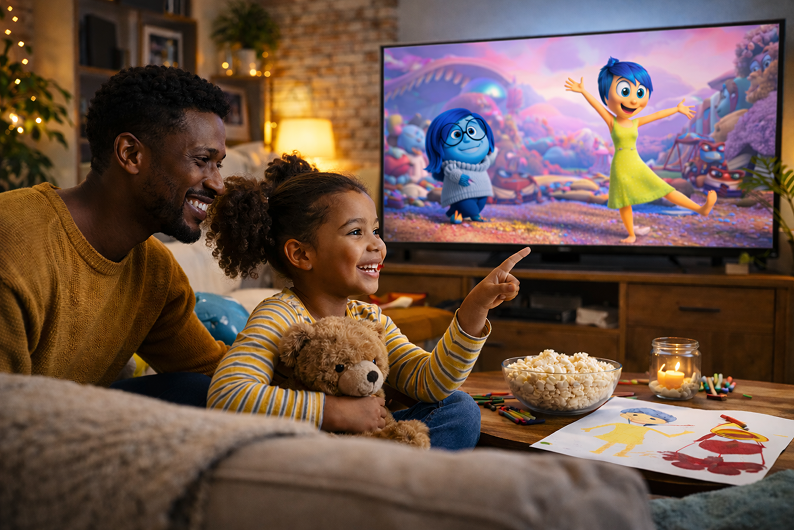
Memories Shape What Matters to Us
Another theme in Inside Out is memory. The film uses “core memories” and “Islands of Personality” to show how meaningful experiences shape Riley’s identity. Pixar describes these core memories as highly significant moments in Riley’s life, and one of the psychological analyses notes that this creates a framework for understanding emotional memory and even attachment.
Of course, this is a filmic simplification. But as a starting point for conversation, it works very well. Families can use this idea to reflect on which experiences shape children most deeply. These do not always have to be dramatic events. Sometimes they are small, repeated moments: being encouraged, feeling left out, being comforted, experiencing belonging, or feeling understood.
This can be especially meaningful during times of transition, such as moving house, changing schools, or adjusting to new friendships. Riley’s story is built around exactly this kind of transition.
What Families Can Take from the Film
Inside Out does not need to be turned into a formal lesson in order to be valuable. Often, a few calm questions after watching it are enough:
- Which emotion felt strongest for you today?
- Is there a feeling people often misunderstand?
- What helps when everything feels mixed together?
- How do you notice when you are sad, overwhelmed, or angry?
These conversations do not need to be long. But they can help children take their inner life more seriously, and help parents listen more carefully.
Why the Film Also Matters for Personal Development
Personal development does not begin in adulthood. It begins when children slowly learn to understand themselves better. That includes not only feeling emotions, but learning how to recognize and interpret them. Inside Out presents that idea in a very accessible way: internal reactions are not random, and even difficult feelings have a place. One of the film’s most valuable aspects is acceptance of all emotions.
There is also a quiet mirror here for adults. Parents do not make decisions purely rationally either. They also react out of tiredness, worry, frustration, or disappointment. In that sense, the film reminds not only children but families as a whole that self-awareness is often the first step toward better conversations and more thoughtful decisions.
Conclusion
Inside Out is more than an entertaining family film. It offers a gentle and understandable way to talk with children about emotions, not in an abstract way, but through images and situations that feel close to everyday life. That is what makes it so useful for families who want to strengthen emotional intelligence, self-awareness, and a calmer way of dealing with difficult moments.
Helping children understand themselves does not always begin with long explanations. Sometimes it begins with a story that shows them that every feeling has its place.
 | General legal and risk notice for blog entries |
Blog entries are general marketing communications and are created for information purposes only.
The information provided is non-binding and does not constitute personalised investment advice or a recommendation to invest in specific asset classes, sectors or companies or an invitation to make an offer to buy or sell certain assets.
Our information does not take into account the individual needs of potential clients with regard to income, tax situation or risk tolerance. Any information on the possible performance of certain asset classes is based on past performance and is not a reliable indicator of future developments.
The content presented is based on the state of knowledge and market assessment at the time this information was prepared. No liability is accepted for the realisation of a forecast situation.
In the event that a link is added to an external website, it is pointed out that no liability is assumed for the correctness and completeness of external information.
Partner Bank Financial Blog
Would you like to be regularly informed about financial topics in the future?
Subscribe to our newsletter now and never miss a blog post again!
Browse by category