

Teaching Children to Save: Anticipation, Pocket Money and Budgeting in Everyday Family Life
Posted by Partner Bank Team 23 Jun 2026
Financial education does not begin in adulthood. It develops in everyday life, often through small moments: while shopping, when handling wishes, or through a child’s first experience with pocket money. These situations shape how children understand money and how they learn to use it.
A conscious approach to money is less about restriction and more about understanding. Children can learn early on to distinguish between short-term impulses and longer-term decisions. Anticipation, pocket money, and simple budgeting habits play an important role in this process.
Why children should learn to save
Children today grow up in a world where many things are instantly available. This makes it even more important to show them that not everything needs to be fulfilled immediately. Saving is not only about setting money aside. It also involves making choices, setting priorities, and developing patience.
When children understand that they can work towards something, their relationship with money changes. A goal becomes more meaningful when it is connected to their own effort. This experience can help build a more stable and realistic approach to consumption and finances over time.
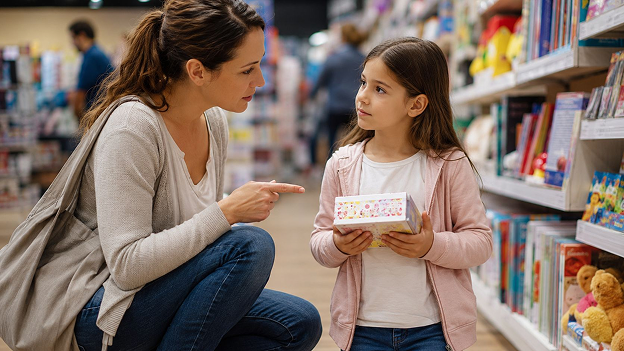

Anticipation as part of the learning process
A key aspect of saving with children is anticipation. When children save up for something, they learn that it is okay for wishes to take time. This phase is not simply “waiting”, it is part of the learning process.
Anticipation strengthens the ability to delay gratification and make more thoughtful decisions. It can also increase the perceived value of what is eventually purchased. An item a child has saved for is often appreciated differently than something received immediately.
Parents can support this by setting clear goals together with their child. A savings goal becomes more tangible when it is visible, for example through a savings jar or a simple list.
Pocket money as a first practical experience
Pocket money is often a child’s first independent experience with money. It allows them to make their own decisions and learn from the outcomes.
Consistency is important. Children should know when they will receive their pocket money and how much it will be. This creates a framework that allows them to plan.
It is equally important to give children some freedom. Small mistakes are part of the learning process. If money is spent quickly, this experience can lead to more thoughtful decisions in the future.
Pocket money is therefore less about control and more about learning responsibility.
Simple budgeting in everyday life
Budgeting does not need to be complex for children. Simple categories are often enough, such as:
- money to spend
- money to save
- money for specific goals
This structure helps children understand that money is limited and needs to be allocated consciously. It also teaches them that not everything is possible at once and that choices are necessary.
The goal is not perfect execution, but basic understanding.
Saving with children in daily family life
Financial education does not happen in isolation, but through daily interactions. Children closely observe how adults handle money. Conversations about decisions, trade-offs, and priorities can therefore be just as important as formal rules.
It is not about explaining everything in detail or justifying every expense. Instead, it helps to involve children in an age-appropriate way and show that financial decisions are part of everyday life.
Handling wishes is also part of this. Not every wish needs to be fulfilled immediately. At the same time, the goal is not to restrict wishes entirely, but to guide them consciously.
Understanding wants and needs
Another important step is learning the difference between wants and needs. For children, this distinction is not always obvious.
Parents can support this by asking simple questions:
- What do I really need?
- What do I want in addition?
- How important is this to me?
These reflections help children understand their own priorities. They support a balanced approach to consumption without focusing on restriction.
A balanced approach: frugality without pressure
Teaching children to save does not mean constant limitation. A balanced approach includes both structure and enjoyment.
Children can learn to handle money responsibly without every wish becoming a problem. The goal is to gradually build an understanding of how decisions are connected and what consequences they may have.
It is not about perfection, but about orientation.
What parents can consider in everyday life
Small steps in daily life can already support children in learning about money:
- provide pocket money regularly and consistently
- define savings goals together
- introduce simple budgeting structures
- allow anticipation to develop
- talk about money in an age-appropriate way
- reflect on wants and needs together
These approaches can help children build a basic understanding of money and gain their first experiences.
A first step toward financial education
Children do not learn about money through theory, but through experience. Anticipation, pocket money, and simple budgeting are practical tools that can be integrated into everyday life.
In the long term, the goal is not to do everything perfectly, but to provide guidance. A conscious approach to money can help children make more informed decisions later and gradually shape their financial future.
Enjoy listening to the podcast “Truly Rich – We Talk About More Than Just Money”
If you would like to explore these topics in greater depth, we invite you to listen to our podcast “Truly Rich”, with the friendly support of Partner Bank. In Episode 2, “Financial education for children, between mindful restraint and joyful anticipation” we discuss how families can help children build a healthy relationship with money, and why values such as responsibility, relationships, and inner wealth also play an important role in financial education.
| You can find the episode on Spotify and Apple Podcasts. |
|


 | General legal and risk notice for blog entries |
Blog entries are general marketing communications and are created for information purposes only.
The information provided is non-binding and does not constitute personalised investment advice or a recommendation to invest in specific asset classes, sectors or companies or an invitation to make an offer to buy or sell certain assets.
Our information does not take into account the individual needs of potential clients with regard to income, tax situation or risk tolerance. Any information on the possible performance of certain asset classes is based on past performance and is not a reliable indicator of future developments.
The content presented is based on the state of knowledge and market assessment at the time this information was prepared. No liability is accepted for the realisation of a forecast situation.
In the event that a link is added to an external website, it is pointed out that no liability is assumed for the correctness and completeness of external information.
How Helpful Was This Article?
Your rating helps us decide which topics to cover in more depth. One click, anonymous.
Partner Bank Financial Blog
Would you like to be regularly informed about financial topics in the future?
Subscribe to our newsletter now and never miss a blog post again!
Browse by category