

More Than a Day of Action: How Partner Bank Thinks About the Future, Education and the Environment
Posted by Partner Bank Team 22 Apr 2026
Earth Day on April 22 is an occasion that reminds us every year that ecological questions are not a side issue. They affect supply, habitats, economic stability and therefore also the question of how future-proof societies really are. This year’s motto from EARTHDAY.ORG, “Our Power, Our Planet,” directs attention to a simple but essential idea: impact happens where people take responsibility, not just occasionally, but consistently.
At the same time, Earth Day does not have to be interpreted in a pathos-driven way. It can also be understood as a thoughtful moment to look at initiatives that think environment and society together. Because sustainable development rarely begins with grand gestures. More often, it begins where knowledge is built, local room for action is strengthened and natural foundations are restored step by step.
Responsibility matters where it is thought through for the long term
Ecological responsibility can only be measured to a limited extent through campaign days. It becomes visible above all in continuity. In the question of whether projects are designed in a way that enables people to carry the work forward themselves. And in the question of whether ecological measures are also socially sustainable.
When we speak about the environment, we are therefore not only speaking about trees, soil or biodiversity in the abstract. We are also speaking about food security, education, income, community and resilience in everyday life. A project that helps plants grow can only create lasting impact if it also transfers knowledge, strengthens local structures and opens up future perspectives.
Earth Day is a meaningful reference point for exactly this reason. Not because a single day solves problems. But because it can draw attention to the kind of development that carries over years.
How Partner Bank understands the future and responsibility
For Partner Bank, responsibility is not a marginal issue. On its sustainability pages, the bank explicitly describes sustainability as an obligation in the financial sector and emphasizes that environmental, social and governance topics are lived dimensions of corporate action. This perspective does not end with internal measures or with the question of how responsible finance can be shaped. It is also reflected in the way long-term social commitment is understood.
A key motif here is education. Partner Bank repeatedly connects future orientation with knowledge, guidance and room to act. This is clearly visible in current content: whether financial education, responsible investing or social development, the central question is consistently how people can be empowered to make sound and sustainable decisions.
This is also exactly where the collaboration with TwoWings fits in logically. According to Partner Bank, it is based on a shared belief in the potential of each individual when education is made possible. That idea is especially relevant for Earth Day. Because the future is not created by attention alone, but by capabilities, structures and reliable partnerships.
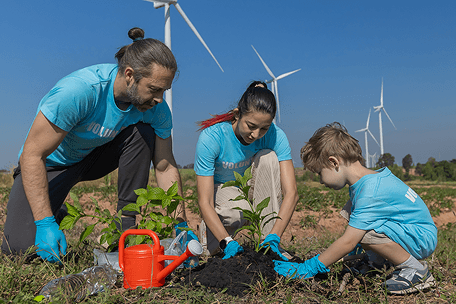
TwoWings and Planting Hope: thinking about environment and society together
Planting Hope is an initiative launched by TwoWings in Linz that combines community development and environmental protection. TwoWings describes Planting Hope as a link between educational work and tree-planting programs intended to support sustainable development, access to food sources and opportunities for families. On the Planting Hope website, this approach becomes even more concrete: the focus is on environmental health, local nurseries, agroforestry, knowledge exchange, collaboration, food security and development opportunities, explicitly including women.
This connection is precisely what makes the approach credible. It is not only about planting trees. It is about how ecological and social interdependence can grow over time: through care, workshops, local participation, the transfer of knowledge and the creation of structures anchored in local communities.
Partner Bank also formulates this connection clearly. On its engagement page, in connection with Planting Hope, the bank refers not only to environmental protection and the restoration of nature, but also to knowledge transfer, work and income opportunities, community and independence. That is exactly what creates an understanding of responsibility that is calm, but substantial.
What concrete impact can mean: from urban gardening to agroforestry
This connection becomes especially vivid in topics such as urban gardening and agroforestry. Partner Bank describes urban gardening as a sustainable method that can improve food security and make meaningful use of urban spaces. In an earlier project presented by Partner Bank in Cali, it became visible how even small spaces, rooftops or areas around homes can become productive places, not as symbols, but as concrete support in the everyday lives of participating families.
Agroforestry expands that idea. It connects agricultural use with the planting and care of trees. Planting Hope describes small agroforestry programs as an approach that supports communities with fruit and other tree seedlings and in this way thinks food security, income opportunities and environmental protection together. In the learnings from the “Transforming the Environment” program in Colombia, there is also mention of more than 2,000 participants gaining agroforestry skills. Planting Hope also reports tree planting in 85 communities as well as the development of local nurseries and monitoring structures.
For Earth Day, what matters here is less the number than the logic behind it: impact emerges where knowledge, practice and responsibility come together. Workshops do not only teach techniques. They create self-efficacy. Local nurseries do not only provide plants. They create infrastructure. And community gardening or planting projects do not only produce green spaces, but often also exchange, cooperation and renewed confidence.
Sustainable development is always social as well
Perhaps this is the strongest link between Earth Day, Partner Bank, TwoWings and Planting Hope: the insight that ecological development falls short if it is separated from its social dimension. For years, TwoWings has worked with the understanding that progress is only sustainable when material and social development go hand in hand. Partner Bank, in turn, repeatedly emphasizes the role of education, self-determination, responsibility and long-term thinking in its own content.
Applied to Earth Day, this means: an intact environment cannot be separated from the realities of people’s lives. Anyone who strengthens food security, shares knowledge about sustainable cultivation methods, opens local income perspectives and restores natural habitats is not working on separate issues. They are working on the same future, from several directions at once.
That is what makes initiatives like Planting Hope credible. Not because they promise simple answers. But because they show that sustainable development can be concrete, learnable and carried by communities.
Outlook
Earth Day on April 22 reminds us that the future does not emerge from attention alone. It emerges where responsibility becomes tangible: in education, in collaboration, in long-term initiatives and in the willingness to think environment and society together rather than apart.
For Partner Bank, this approach is a natural fit. Not as a short-term gesture, but as a matter of conviction: future orientation means supporting developments that strengthen people and take natural foundations into account. The collaboration with TwoWings and Planting Hope makes visible how this aspiration can become concrete fields of action, from urban gardening and agroforestry to knowledge transfer, food security, biodiversity and community development.
Seen this way, Earth Day is not an isolated date. It is a meaningful occasion to look at the kind of work that begins quietly, is designed for the long term and creates impact where it matters most: in people’s lives and in the living environments on which the future depends.
 | General legal and risk notice for blog entries |
Blog entries are general marketing communications and are created for information purposes only.
The information provided is non-binding and does not constitute personalised investment advice or a recommendation to invest in specific asset classes, sectors or companies or an invitation to make an offer to buy or sell certain assets.
Our information does not take into account the individual needs of potential clients with regard to income, tax situation or risk tolerance. Any information on the possible performance of certain asset classes is based on past performance and is not a reliable indicator of future developments.
The content presented is based on the state of knowledge and market assessment at the time this information was prepared. No liability is accepted for the realisation of a forecast situation.
In the event that a link is added to an external website, it is pointed out that no liability is assumed for the correctness and completeness of external information.
How Helpful Was This Article?
Your rating helps us decide which topics to cover in more depth. One click, anonymous.
Partner Bank Financial Blog
Would you like to be regularly informed about financial topics in the future?
Subscribe to our newsletter now and never miss a blog post again!
Browse by category